Infinite Loop
Here on campus there are two types of buses that can be found: Loop and Metro. The Loop buses are also sub-divided into regular loop buses labelled “Loop” and another group labelled “Upper Campus”. To be honest I still don’t really know the difference between upper and lower campus. I define the school’s geography as “Buildings/Lecture Halls” and “Middle of nowhere”. Regardless of my ignorance toward the formal titles of the loop buses and sections of campus, one thing I really don’t understand (that I have tried to understand) is the loop bus schedule.
According to taps.ucsc.edu, the buses all depart from a certain stop at a certain time and then return to that stop 30 minutes later. This schedule is fine for planning ahead and getting to class at certain times, but what really bothers me is the moments when I need to hastily rush to another part of campus for one-time occurrences.
In these moments, I arrive at the bus stop closest to my dorm building with a snap decision to make: Do I speed-walk to my destination in 10-20minutes or do I stick around and hope a loop bus comes quickly? It’s a tough decision, really, and making the wrong one puts salt in my wound as I’m walking super fast and about ¼ of the way there the loop bus passes by me and I refuse to look at it, refuse to admit the shuttle system has gotten the best of me again.
I’ve started trying to find ways to gauge when the next loop bus will come. I usually look at the number of people waiting at the bus stop, trying to use them as an indicator that a bus hasn’t come for a while so one must be coming up rather soon. But in the back of my head there is always the voice nagging at me “What if one doesn’t come soon? What if you’re just standing here wasting your time when you could be ¼ of the way there already?”
Many times I decide to just walk and I find myself constantly looking over my shoulder while the bus stop is still in sight, just in case a loop decides to sneak up on me. There have been a couple of instances when this practice has worked in my favor (you know, aside from me having to actually speed walk back to the bus stop, but hey I count my blessings).
By now some of you may be asking, “Why don’t you just google the next Metro bus time and take that?” Well, every time a student gets on a metro bus the university is charged something like $1.30. Doesn’t seem like much but when you think about how there are approximately 60 to 70 people on the bus, times all of the buses, times all of the people getting on after some others get off, time all of the hours the buses run, it’s a lot of money. Students are usually told to just use loops for campus transportation, so I try my best to honor that. If no one gave a damn about it, tuition would eventually rise, and then there will be another strike, and then people will get arrested again. (No offense UAW I’m totally with you on your unfair wage complaints and all but if you ever try to block the entrance of campus again to prevent all of these students paying for classes from getting to class, I’m going to rage so hard).
Anyway, I really think that if I just sat down for maybe an hour and really reviewed the loop bus schedule for every single weekday I could begin to gauge (or just memorize) the times at which a loop will arrive. However, this doesn’t help me when I’m done with whatever I was doing and trying to return from some random bus stop on campus. The struggle is real.
Oh well, in the end whether I get to ride the loop or not is not that big of a deal. This is mostly just a trivial mental game I’m playing, trying to master the system of public transportation.
I’ll win one day. “Ride or die.”
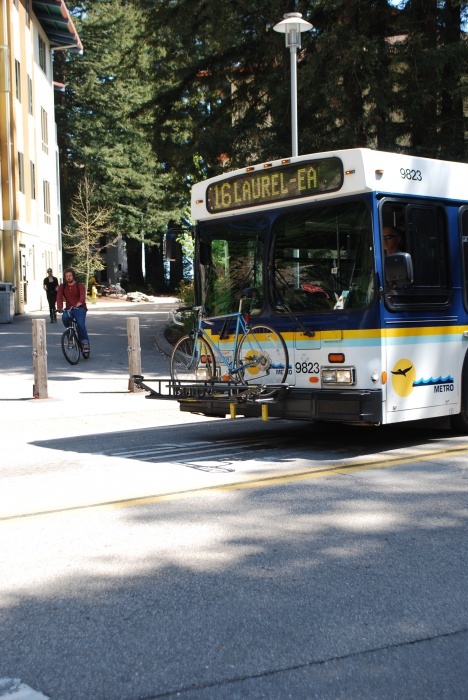
(Santa Cruz Metro Bus via City On A Hill Press)